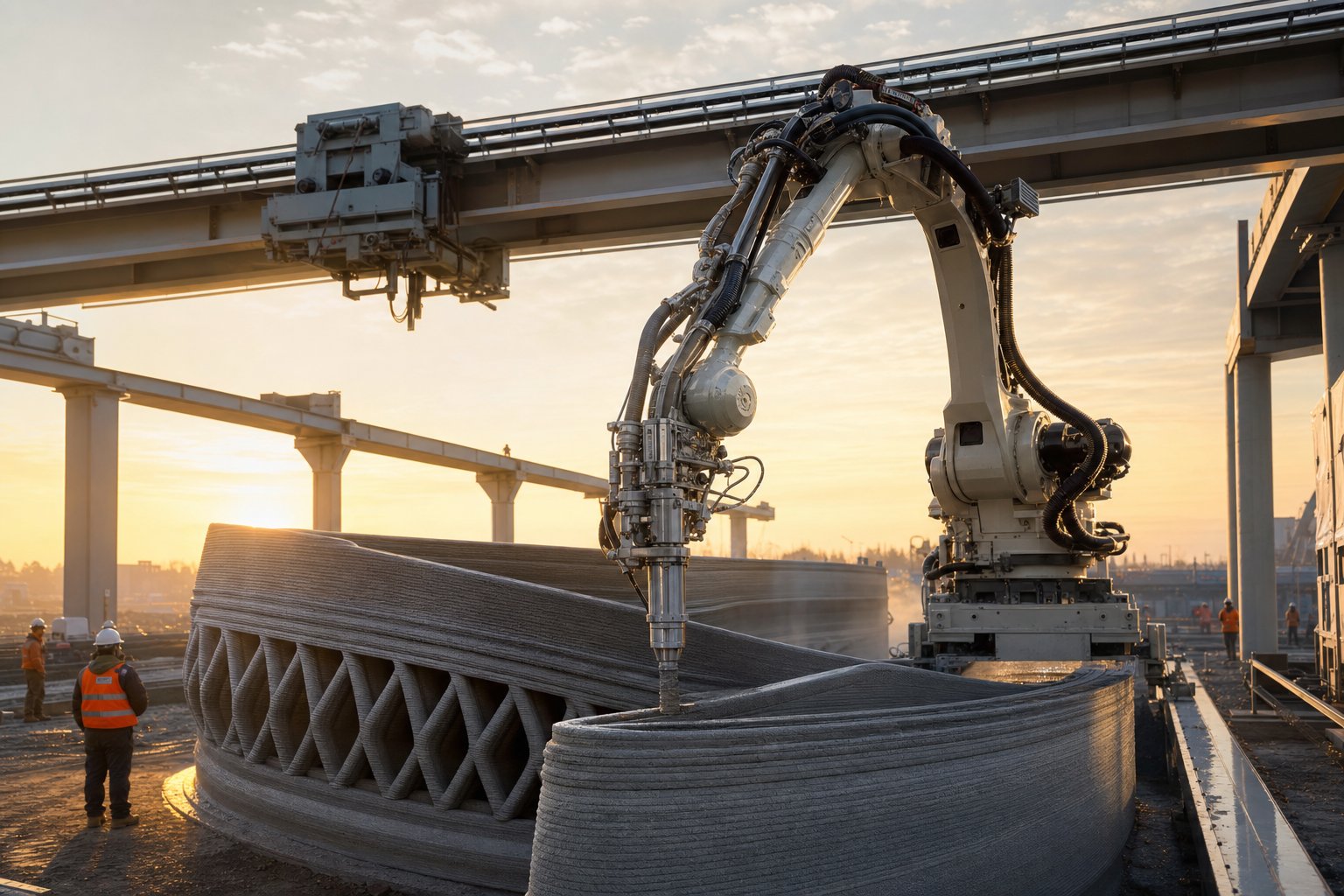
Robotic 3D printing large format industrial infrastructure is no longer a research curiosity. Across construction sites, pipe fabrication yards, and civil engineering projects, multi-axis robotic systems are depositing material at scales — and in geometries — that conventional forming, casting, and assembly methods cannot match.
This article examines how these systems work, what materials and processes are in use today, and where the real-world applications are taking hold.
How Large-Format Robotic Additive Systems Are Built
Two broad motion architectures dominate the large-format space: gantry systems and 6-axis robotic arm systems.
Gantry-Based Systems
Gantry machines mount a print head on an overhead X-Y-Z frame. Build volumes can extend to tens of meters in length, making them well-suited for linear infrastructure components — pipe sections, bridge beams, and precast wall panels. The tradeoff is motion complexity: gantries excel at orthogonal paths but require additional axes or tilting heads to deposit material at non-perpendicular angles.
Companies like Thermwood (LSAM — Large Scale Additive Manufacturing) and Cincinnati Incorporated (BAAM — Big Area Additive Manufacturing) have commercialized gantry platforms primarily for fiber-reinforced thermoplastic composites, targeting tooling, molds, and structural end-use parts.
6-Axis Robotic Arm Systems
Industrial robots from KUKA, ABB, and Fanuc — with reach envelopes of 2–4 meters — are increasingly used as motion systems for additive deposition. A process-specific end effector (extrusion head, welding torch, or laser DED nozzle) replaces the conventional robot tool.
The key advantage is non-planar deposition: a 6-axis arm can orient the print head at arbitrary angles, enabling curved layer surfaces, overhangs without support, and deposition along structural load paths. For infrastructure components with complex geometry — curved pipe elbows, branching utility manifolds, or arch segments — this matters.
Materials and Processes in Use
Concrete and Cementitious Extrusion
Concrete extrusion is the most widely deployed large-format additive process for infrastructure. Systems from COBOD, ICON, and others pump a precisely mixed cementitious paste through a nozzle, building walls and structural elements layer by layer.
Mix design is critical: the material must be pumpable (low enough yield stress to flow through the hose) yet self-supporting immediately after deposition (high enough thixotropic recovery to hold its shape). Accelerators — typically shotcrete-grade admixtures — are often injected at the nozzle to accelerate stiffening on contact.
For pipe applications, concrete 3D printing systems are being adapted to produce custom culvert sections, junction boxes, and segmental tunnel linings that would otherwise require dedicated formwork.
Wire Arc Additive Manufacturing (WAAM)
WAAM uses a robotic arc welding process — MIG, TIG, or plasma — to deposit metal feedstock wire in beads that fuse and solidify layer by layer. The process scales readily to meter-class parts and has been applied to ship propellers, structural steel nodes, and pressure vessel components.
For industrial infrastructure, WAAM’s appeal is the ability to produce large, near-net-shape metal components without the lead times and tooling costs of forging or casting. Wall thicknesses, internal features, and alloy compositions can be varied within a single build.
Fiber-Reinforced Thermoplastics
Pellet-fed extruders — rather than filament — are standard at large format. Systems ingest chopped carbon or glass fiber-reinforced polymer pellets and extrude beads 5–25mm wide. Parts can be printed in hours that would take weeks to layup by hand, and the embedded fiber reinforcement provides mechanical properties suitable for structural tooling and secondary structural components.
Infrastructure Applications: Where Scale Meets Practicality
Pipe and Underground Utility Components
Large-format pipe manufacturing using additive methods addresses a specific industry pain point: short-run custom components. Standard pipe is cheap; the transition fittings, reducers, inspection chambers, and bespoke junction pieces are expensive and slow to procure.
Robotic extrusion systems can produce HDPE and polypropylene pipe components in diameters exceeding 600mm, with wall thicknesses and geometries impossible with conventional extrusion dies. Projects in water infrastructure have used concrete printing to produce culvert sections and sewer junctions on-site, reducing transport costs and avoiding standard-size constraints.
Structural Architecture and Civil Frameworks
For construction, the enabling capability is removing formwork from complex structural pours. A robotic concrete system can print a curved retaining wall or a non-orthogonal column cap directly — no mold, no stripping, no waste material to dispose of.
Printed concrete does require attention to layer interface bonding. Vertical load capacity is well-established; horizontal shear across printed layers is the more critical design consideration, addressed through surface texture, layer timing, and mix thixotropy.
Bridge and Civil Infrastructure Components
Several bridge projects in Europe and the Middle East have used robotic additive systems to produce pedestrian bridge spans and abutment components. The structural case rests on topology optimization: additive can place material only where load paths require it, reducing mass while maintaining capacity.
Technical Considerations and Current Limits
Tolerance and surface finish remain lower than machined or cast parts. Most robotic extrusion processes hold ±2–5mm positional accuracy across large builds — adequate for civil and infrastructure work, but not for precision mechanical assemblies.
Layer adhesion monitoring is an active area. Thermal cameras, structured light scanning, and ultrasonic inspection are being integrated into robotic cells to catch delamination or geometric drift mid-print, rather than discovering defects after a multi-hour build.
Print path planning for non-trivial geometries requires software that goes beyond conventional slicer tools. Infrastructure components with embedded conduits, varying wall thickness, or structural reinforcement require path strategies that balance deposition rate, layer overlap, and thermal history.
Where the Technology Stands
Robotic large-format additive manufacturing is a production technology, not a prototype one — but it earns its place on specific project types: low-volume custom components, on-site fabrication where transport is the constraint, and geometries that defeat forming tooling. It is not yet a replacement for mass-produced pipe, structural steel, or precast concrete at volume.
The systems that are working in practice share common traits: narrow material envelopes they have characterized thoroughly, robust process monitoring, and applications where the geometric or logistical advantage offsets a higher per-part cost than conventional methods.
For infrastructure sectors dealing with aging networks, custom replacement components, and constrained site access, those conditions are met more often than the industry once assumed.